




The architecture, engineering, and construction (AEC) industry is in the midst of an artificial intelligence investment surge. Generative design tools now produce thousands of layout options in hours. Predictive scheduling algorithms promise to cut delays by double digits. Automated compliance checkers scan BIM models against building codes faster than any human reviewer.
But there is an uncomfortable question that many AEC leaders are asking: Can we trust these systems? The evidence suggests caution.
A 2024 study published in Automation in Construction found that while AI excels at structured compliance tasks, it exhibits “significant deficiencies in handling contextual nuance, ensuring accountability, and providing transparent reasoning” when applied to complex, high-stakes construction environments.
Another peer-reviewed analysis from researchers at the University of Cambridge concluded that industry experts have “considerable reservations regarding the autonomous use of AI for ethical judgments,” strongly advocating for robust human-in-the-loop oversight across design and construction workflows.
The biggest barrier to scaling AI governance AEC, however, isn’t computing power or algorithm quality. It’s trust.
In high-consequence fields where design decisions directly affect life safety, structural integrity, and long-term durability, AI governance (the active frameworks ensuring transparency, accountability, and security) is rapidly shifting from a compliance burden to the ultimate AI competitive advantage for forward-thinking AEC firms.
Unique Governance Chasm in AEC: Why Generic Frameworks Fail
Responsible AI construction cannot be achieved through generic data privacy policies or off-the-shelf compliance tools. AEC projects operate under unique conditions: multi-year lifecycles, dozens of collaborating firms, strict building codes, and zero tolerance for catastrophic failure.
The risks of ungoverned AI in this environment are severe:
- Data Integrity & Bias: AI models trained on incomplete or non-representative project datasets risk producing outputs that appear statistically valid but lack contextual validity for specific sites, materials, or regulatory jurisdictions.
- Explainability & Liability: When an AI-generated design recommendation or safety alert influences a real-world decision, lack of transparency creates ambiguous liability. Who is responsible when an AI-supported structural optimization fails?
Horizontal compliance frameworks such as the GDPR or SOC2 are necessary but insufficient for AEC. They address data privacy and security but do not engage with domain-specific requirements such as building code verification, structural safety margins, or construction risk management.
Many firms treat AI risk management framework adoption as an afterthought; a policy document written after the technology is already deployed. This leads to fragmented, uncoordinated AI experiments that create more operational and legal risk than business value.
New Imperative: From Blind Adoption to Active Governance
Here is the shift that separates market leaders from laggards: governance is the enabler of innovation at scale.
We must distinguish between passive compliance and active governance.
- Passive Compliance: A reactive checklist designed to avoid fines or pass audits. It produces paperwork, not performance.
- Active Governance: A proactive, embedded performance layer that ensures AI reliability, auditability, and continuous improvement across every project phase.
The business case for active governance is becoming unmistakable. A 2025 report from the NIST National Cybersecurity Center of Excellence explicitly calls for “trustworthy AI” frameworks to be operationalized for critical infrastructure sectors (including construction and building systems) not as optional add-ons but as foundational requirements.
Firms that articulate a clear Trustworthy AI built environment approach show foresight, maturity, and reliability to safety-conscious clients and regulators. As a result, major project owners are beginning to include AI governance criteria in RFPs.
Soon, the question won’t be “Do you use AI?” but rather “Can you prove your AI is governed?“
“Black Box” to Blueprint: Governance as Technical & Social Architecture
Effective AI ethics engineering requires more than technical controls. It requires understanding that governance operates at two levels simultaneously.
The Technical Core: NIST AI Risk Management Framework
The NIST AI RMF (Artificial Intelligence Risk Management Framework) has become the most rigorous, repeatable framework for including trustworthiness into AI design, development, and deployment.
Originally developed for general enterprise use, it is now being operationalized specifically for critical infrastructure sectors, including energy, water, transport, and building systems. This is where safety-related AI tasks demand documented, auditable risk controls.
The Social Dimension of Governance
But technical frameworks alone are insufficient. Peer-reviewed research in Computer Supported Cooperative Work emphasizes that AI governance AEC must also address the “social architectures” (bureaucratic routines, accountability hierarchies, and professional norms) that mediate how technology is actually used on construction sites and in design offices.
An AI tool with perfect technical governance will still fail if project teams lack clear protocols for when and how to override its recommendations. AEC governance, therefore, must address both the code and the culture.
Operationalizing the Standard Using ISO 42001 for AEC
For organizations seeking a certifiable, auditable framework, ISO 42001 AEC represents the new gold standard. ISO/IEC 42001 is the primary international standard for establishing, implementing, and continually improving an AI management system (AIMS).
How does this apply to construction? Here is a concrete example: AI Clearing, a construction analytics firm, achieved the world’s first ISO 42001 certification specifically to address the unique AI management challenges in heavy civil construction. Their certification proves that their AI systems are being developed ethically, safely, and responsibly across three pillars: AI governance, risk management, and lifecycle quality assurance.
For AEC leaders considering ISO 42001 AEC adoption, the standard raises several practical questions:
- Are clients and stakeholders informed about how AI is used and what data is collected?
- Are risk assessments documented and shared with relevant project teams?
- Do lifecycle management plans account for future updates, retraining, or retirement of AI tools?
Considering the countless loopholes, redundancies, and ethical issues that may arise with AI tools, these questions are actually becoming contractual requirements.
How Achievion Embeds Trust from Day One
At Achievion, we do not treat governance as an afterthought bolted onto completed systems. We architect it into every custom AI solution for our AEC partners from the first line of code.
Our integration model includes three core components:
Lifecycle-Based Governance
We operationalize frameworks like NIST AI RMF directly into our clients’ software development lifecycle (SDLC). Governance steps (risk assessment, bias testing, and documentation) are fixed from initial design through deployment and ongoing monitoring, instead of being added as a final compliance hurdle.
Human-in-the-Loop Validation
We build mandatory professional review stages for all AI-generated outputs affecting BIM models, cost forecasts, design recommendations, or safety alerts. This ensures AI augments expert engineering judgment rather than attempting to replace it, directly addressing the AI reservations documented by professionals across the globe and a wide range of industries.
Security & Resilience
Our solutions are built with what we call a “digital citadel” mindset, creating security controls from day one to protect against the exponential risks created by connected AI agents accessing BIM, ERP, and real-time site data.
This approach turns AI risk management framework compliance from a cost center into a competitive differentiator.
Why Governance Laggards Will Lose in Case of Inaction
What happens when AEC firms ignore active AI governance? The consequences extend far beyond technical failures, turning into financial, legal, reputational, and operational problems. In an industry where margins are measured in basis points, inaction can not be equated to neutrality but a competitive catastrophe.
Financial Risk
Ungoverned AI systems produce outputs that appear confident but may be dangerously wrong. The financial impact can be seen quite clearly:
- Cost overruns from undetected schedule conflicts,
- Rework from AI-generated design clashes that pass human review because the system provided no uncertainty quantification, and
- Legal exposure from flawed automated code checks that miss critical safety requirements.
A 2025 study found that AEC firms without formal AI governance frameworks experienced 30-50% higher rework costs on AI-assisted projects compared to those with structured governance, primarily due to undetected data drift and model output errors.
Regulatory & Legal Exposure
Regulators are catching up to AI deployment. The European Union’s AI Act, fully enforceable in 2025, classifies certain AEC AI applications (e.g., structural safety assessments, compliance checking for building codes) as “high-risk,” mandating strict conformity assessments, risk management systems, and human oversight. Non-compliance carries fines of up to €35 million or 7% of global annual turnover.
In the United States, the NIST AI Risk Management Framework is increasingly being referenced in federal construction contracts as a recommended standard. While not yet mandatory, legal experts predict that failure to adopt recognized AI risk management framework practices will become evidence of negligence in product liability lawsuits involving AI-generated design or safety failures.
Reputational & Client Trust Damage
Trust is the currency of the AEC industry. Clients (especially public agencies, healthcare systems, and infrastructure owners) are beginning to ask pointed questions about AI governance during procurement.
A 2025 survey of 200 major project owners conducted by the Construction Industry Institute found that 68% would disqualify an AEC firm from consideration if the firm could not show a documented, auditable AI governance framework for any AI tools used in design, cost estimation, or scheduling.
Once lost, reputational trust is nearly impossible to rebuild. A single high-profile failure (a collapsed structure traced back to an ungoverned AI design recommendation, or a permit denied due to flawed automated code checking) can permanently damage a firm’s standing with regulators, insurers, and clients.
Operational Inefficiency & Talent Drain: The Hidden Erosion
Beyond external risks, internal operations suffer. Without Responsible AI construction governance, different project teams develop their own ad hoc, incompatible approaches to AI use. The result: fragmented workflows, duplicated effort, and inability to share validated AI models across projects.
This chaos drives away top talent. Data scientists, AI engineers, and compliance professionals increasingly seek employers with mature AI ethics engineering practices. A 2024 LinkedIn Workplace Culture Report noted that 53% of AI professionals consider “clear ethical AI and governance policies” a non-negotiable factor in job selection.
Firms that treat AI governance AEC as an afterthought will find themselves unable to hire the very people needed to fix the problem, creating a downward spiral of technical debt and competitive irrelevance.
A Practical Governance Framework for AEC Leaders
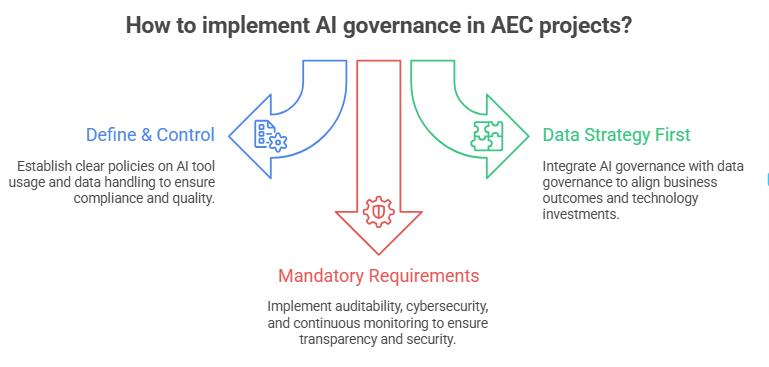
For CTOs and innovation leaders who want to move from theory to action, here is a practical starting framework:
Establish clear policies on which AI tools are approved for specific project types, what data can be uploaded to external AI services, and how AI-generated outputs are reviewed before inclusion in contract documents or permit submissions.
Next, acknowledge that AI governance AEC is inseparable from data governance. Separating AI strategy from data strategy “creates misalignment between business outcomes and technology investments.”
This leads to three mandatory requirements for the implementation:
- Auditability: Implement transparent audit trails for every AI-driven decision affecting project cost, schedule, or safety.
- Cybersecurity: Mandate robust security protocols for all AI tools and data pipelines, including third-party SaaS AI products.
- Continuous Monitoring: Require to ongoing performance audits to identify and correct model drift, bias emergence, or accuracy degradation over time.
The Governed AI Advantage
In the AEC industry, the ultimate competitive advantage will not belong to the firm with the most powerful generative design engine or the most aggressive automation roadmap. It will belong to the firm that can prove its AI is trustworthy.
You should stop treating AI governance as a policy document gathering dust on a SharePoint site. Instead, treat it as the architecture that will determine whether your AI investments build a durable competitive moat or crumble into liability.
Achievion partners with AEC firms to move beyond fragmented pilots and “black box” AI. We design and build governed, custom AI solutions that are secure, compliant, and ready to scale. We also help translate high-level frameworks like NIST AI RMF and ISO 42001 AEC into enforceable engineering controls for your unique AEC workflows.
For every aspect of the architecture, we help you build with trust as a design feature, ensuring your AI competitive advantage is both powerful and proven.