



The 73% Question
Only 27% of architecture, engineering, and construction firms currently use AI for automation, problem-solving, or decision-making, leaving nearly three-quarters of the industry outside active adoption. A direct result of this is that this statistic often frames it as a technology adoption failure, a story of conservative industries resisting change.
However, it is important to note that this framing misses the real problem entirely. The barrier of note here is not exactly the shortage of AI tools or a lack of data. Instead, AEC firms generate enormous volumes of information daily, ranging from BIM models to CAD drawings, schedules, RFIs, estimates, ERP records, site imagery, LiDAR scans, and IoT sensor streams. The problem is that this information remains fragmented, inconsistent, and insufficiently governed to support reliable AI systems.
A global survey of over 2,200 construction professionals found that 74% of organizations report limited or no preparation for AI, with fewer than 1% having scaled AI operationally across projects. The most frequently cited barriers were skills shortages (46%), system integration challenges (37%), and data quality and availability issues (30%).
These might seem like tool-acquisition problems, but instead are actually data-foundation problems. They explain clearly why the 73% adoption gap persists despite growing enthusiasm for AI across the industry.
What AI Readiness Actually Means
AI readiness in the AEC context is not the ability to provide employees with generative AI tools. It is the organizational capacity to integrate and use AI reliably in business workflows. This endeavor requires extensive data maturity, i.e., the ability to:
- Consistently collect project and enterprise data,
- Structure and contextualize it,
- Make it accessible across systems,
- Establish quality and ownership controls,
- Maintain lineage and permissions, and
- Render information machine-readable for AI consumption.
Possessing BIM models does not automatically mean possessing AI-ready data. BIM models frequently contain incomplete metadata, different disciplines follow inconsistent naming and classification practices, and valuable project context remains trapped outside BIM in PDFs, spreadsheets, emails, field systems, and ERP platforms.
A useful distinction separates three states of information:
- Digitized (information exists electronically),
- Connected (information can move across systems), and
- AI-ready (information is structured, contextualized, trusted, governed, and accessible to AI).
Most AEC firms operate firmly in the digitized state, with varying degrees of connectivity. Very few have reached genuine AI readiness.
Why AEC Data Is Uniquely Difficult
The AEC industry’s project-based, multidisciplinary structure creates data fragmentation at every level. Teams work across different BIM, CAD, and project-management platforms. Contractors, consultants, and subconsultants operate on different systems with different data standards.
Long asset lifecycles mean information must survive decades of organizational handoffs and legacy file formats. This fragmentation includes BIM and design repositories, estimating and cost systems, schedules, document management, ERP and procurement platforms, field applications, photos, scans, sensor data, and operations and asset-management systems.
It is important to note that only 11% of surveyed firms are fully digital, with many still relying on paper and legacy workflows. Data sharing security (42%) and cost and complexity (33%) were the top integration challenges reported by respondents. When AI models operate against disconnected or outdated information, they may generate technically plausible answers without sufficient project context.
This shows that AI exposes existing information-management weaknesses, but does not automatically solve them.
The Warning Signs
Several diagnostic indicators reveal when AEC data is not AI-ready. Teams work from duplicate drawings, spreadsheets, BIM exports, or outdated files, creating multiple versions of the truth. BIM, scheduling, estimating, ERP, and field systems cannot exchange information cleanly, trapping data in application silos.
Naming, classification, object properties, and project structures vary across teams and projects, producing weak metadata and inconsistent semantics. Important knowledge remains buried in PDFs, specifications, RFIs, site imagery, email, and free-form documents.
Ownership and governance remain undefined, with teams unable to answer who owns data, who may access it, which source is authoritative, or how long it should be retained. Staff repeatedly re-enter, export, clean, or reconcile information between platforms through manual handoffs.
These symptoms connect directly to the system integration and data quality barriers identified in global research. Addressing them requires more than new software; it requires a structured approach to measuring and improving data maturity.
A Five-Level Data Maturity Model
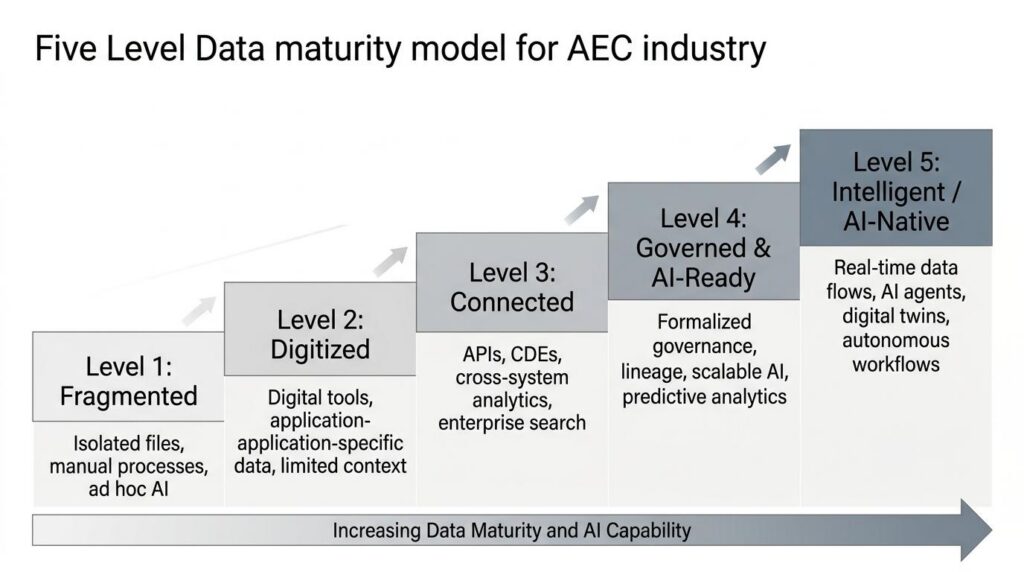
A practical diagnostic framework for AEC organizations uses five maturity levels.
At Level 1 (Fragmented), information resides in isolated files and applications, with heavy dependence on spreadsheets, PDFs, manual exports, and individual knowledge. AI use is mostly ad hoc.
At Level 2 (Digitized), major workflows use digital tools and BIM, but data remains application-specific and difficult to reuse across projects. Basic copilots and standalone AI tools are possible, but enterprise context is limited.
At Level 3 (Connected), APIs, common data environments, and data pipelines connect important sources, with common identifiers and standards improving interoperability. Cross-system analytics and enterprise search become feasible.
At Level 4 (Governed & AI-Ready), data quality, lineage, ownership, permissions, metadata, validation, and lifecycle controls are formalized. AI applications can reliably access approved business and project context, enabling predictive analytics, retrieval-augmented generation systems, and custom domain AI to scale.
At Level 5 (Intelligent/AI-Native), data flows continuously across project systems and physical operations, allowing AI agents, predictive digital twins, multimodal models, and automated workflows to act against trusted real-time context.
Research on BIM and AI integration confirms that the technology remains in nascent stages precisely because data interoperability and standardization challenges persist across platforms. The AEC industry’s fragmented nature, where different organizations control various construction phases, presents a fundamental challenge to amassing the structured data required to train supervised learning algorithms.
What an AI-Ready Foundation Requires
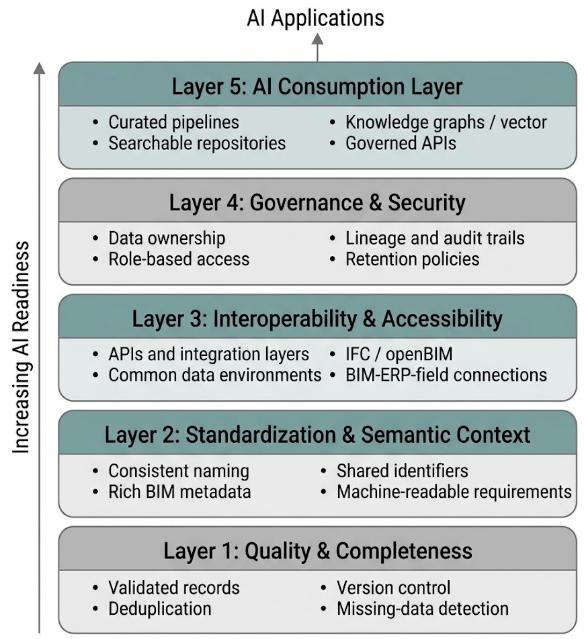
Building an AI-ready data foundation requires five interconnected layers.
- Quality and completeness: validated project records, deduplication, version control, and missing-data detection.
- Standardization and semantic context: consistent naming and classification, rich BIM metadata, shared project identifiers, and machine-readable information requirements.
- Interoperability and accessibility: APIs and integration layers, common data environments, IFC and openBIM where appropriate, and connections between BIM, ERP, scheduling, estimating, and field platforms.
ISO 19650 and buildingSMART openBIM provide useful foundations for structured information management and interoperability, though they should not be presented as AI standards themselves. Research exploring the integration of openBIM data formats with ISO 19650-4 shows that foundational standards such as IFC and bSDD show strong semantic and structural alignment, while evolving standards like IDS and openCDE offer precision and operational flexibility.
Case studies from major infrastructure projects validate the practical benefits of standardized openBIM implementation in improving coordination and reducing project risk.
- Governance and security: data ownership, role-based access, lineage, retention policies, audit trails, and privacy controls. The fifth is an AI consumption layer: curated data pipelines, searchable document repositories, knowledge graphs or vector retrieval, and governed APIs through which AI applications access enterprise information.
Matching AI Ambition to Data Maturity
AI ambition should match data maturity. At the Fragmented level, realistic AI opportunities are limited to standalone copilots, summarization, and individual productivity tools. At the Digitized level, document classification, OCR, and basic search and automation become feasible.
At the Connected level, cross-project search, RAG assistants, and automated reporting become possible. At the Governed/AI-Ready level, predictive cost and schedule models, design intelligence, and compliance analysis can be deployed. At the AI-native level, AI agents, predictive digital twins, multimodal automation, and autonomous workflows become viable.
Firms often fail by jumping directly to advanced AI use cases without building the supporting data layer. The sophistication of an AI system cannot sustainably exceed the maturity of the information environment supporting it. Research on machine learning adoption in AEC identifies data sharing, acquisition, and labeling as major barriers to scaling ML solutions, with both academic and industry communities in agreement on these constraints.
A Five-Phase Roadmap for Closing the Gap
Closing the data maturity gap requires a structured, phased approach.
- Phase 1 involves assessing current data maturity by inventorying systems, repositories, formats, workflows, owners, and integration points, and identifying where critical data becomes duplicated, inaccessible, or unreliable.
- Phase 2 starts with high-value AI use cases rather than attempting to clean every dataset first. High-value workflows such as estimating, schedule risk, document intelligence, BIM analysis, or field reporting provide concrete targets. Teams work backward to identify the data those use cases require.
- Phase 3 connects and standardizes the foundation by building required pipelines and APIs, standardizing identifiers and metadata, establishing common data environments or integration layers, and converting valuable unstructured information into searchable, contextualized data.
- Phase 4 establishes governance from day one, defining ownership, access, lineage, validation, security, and acceptable AI-use policies to ensure approved data feeds AI systems.
- Phase 5 involves piloting, measuring, and scaling: validating one or two business-critical AI workflows, measuring accuracy, adoption, time saved, cost impact, and risk reduction, and expanding the architecture across additional teams and projects once the foundation proves reliable.
Data modernization should be tied to business outcomes, not pursued as an endless IT cleanup program.
The Compounding Advantage
The data maturity gap is becoming a competitive advantage gap. Bluebeam’s research shows that 94% of current AI users plan to expand their use, with 68% of early adopters reporting at least $50,000 in savings and 46% reclaiming 500–1,000 hours through AI tools.
Autodesk’s survey of over 3,500 industry leaders found that construction companies fully automating their workflows and actively integrating AI are outperforming their peers, with digital leaders exhibiting higher optimism about their financial future.
This creates a compounding advantage: cleaner data enables better AI, better AI produces stronger operational outcomes, successful outcomes justify further investment, and accumulated project intelligence makes subsequent models more valuable.
The opposite is equally true. Fragmented data leads to weak AI results, poor trust, stalled investment, and a growing competitive gap. The firms gaining the largest AI advantage may not be those buying the most AI software; they will be those creating the strongest information foundation underneath it.
FAQ: AEC Data Maturity and AI Readiness
What is data maturity in AEC?
Data maturity refers to an organization’s ability to consistently collect, structure, contextualize, govern, and make accessible the project and enterprise data required to support reliable AI systems. It exists on a spectrum from fragmented (Level 1) to AI-native (Level 5), and most AEC firms currently operate between Levels 1 and 2.
What makes construction data AI-ready?
AI-ready data is structured, contextualized, trusted, governed, and machine-readable. It includes consistent naming and classification, rich metadata, clear ownership, defined access controls, and the ability to move across systems through APIs and common data environments. Without these properties, AI systems cannot reliably interpret project context.
Does having BIM mean an AEC firm is ready for AI?
No. BIM models frequently contain incomplete metadata, inconsistent naming practices across disciplines, and valuable context stored outside the model in PDFs, spreadsheets, and emails. BIM is a critical data source, but it is rarely AI-ready in isolation. Firms must connect BIM data to enterprise systems and establish governance before AI can use it reliably.
Why is fragmented data a problem for construction AI?
AI systems require context to produce reliable outputs. When models operate against disconnected or outdated information, they may generate technically plausible answers that lack sufficient project context, leading to poor decisions and eroding trust in AI systems. Fragmentation also prevents firms from scaling successful pilots across projects.
Do AEC firms need to replace legacy systems before adopting AI?
Not necessarily. Effective AI-ready architectures can connect existing platforms through APIs, integration layers, and common data environments without requiring wholesale replacement of established systems. The goal is interoperability and governance, not system replacement for its own sake.
What role do common data environments play in AI readiness?
Common data environments provide a single source of truth for project information, enabling consistent access, version control, and governance. They form a critical bridge between fragmented project data and the connected, governed foundation AI systems require. Without a CDE or equivalent integration layer, AI applications lack reliable access to approved project context.
How do IFC and openBIM improve AI interoperability?
IFC and openBIM standards provide structured, machine-readable formats for exchanging information across different software platforms. They improve interoperability and semantic consistency, making it easier to build AI systems that can access and interpret data from multiple sources. These standards are foundations for structured information management, not AI standards themselves, but they significantly reduce integration friction.
What should an AEC firm fix first before scaling AI?
Start by assessing current data maturity and identifying high-value AI use cases. Then connect and standardize the data foundation those use cases require, establish governance from day one, and pilot before scaling. Attempting to clean every dataset before starting will stall progress; working backward from a specific use case creates momentum and measurable results.
Moving Forward
AEC firms already possess enormous amounts of potentially valuable information, but much of it is not yet structured, connected, governed, or reusable enough to support AI at scale. The 73% adoption gap should be treated as an infrastructure and organizational-readiness opportunity, not evidence that AI has failed in AEC.
Firms that build mature information foundations today will be better positioned for the next wave of predictive AI, multimodal systems, digital twins, and autonomous agents. Before asking which AI platform to buy, CTOs and innovation leaders should ask whether their data can support the AI capabilities they want to deploy.
Achievion helps AEC organizations close the gap between possessing vast amounts of digital information and having data that can reliably power production AI. From AI and data readiness assessments to AI-ready data architecture, interoperability engineering, governance frameworks, and custom AI development, Achievion builds the foundational layers that turn fragmented BIM models, enterprise systems, and field data into a connected, governed, and machine-readable information ecosystem.
In an industry where the sophistication of AI cannot sustainably exceed the maturity of the data supporting it, building that foundation is not a preliminary step—it is the competitive advantage itself.